Outside the lido gates at half past six, there is already a queue. Most of the people in it are wearing a bathrobe over a costume, holding a flask, and saying almost nothing to each other — not because they are unfriendly, but because everyone is quietly negotiating with the fact that the water is eleven degrees and they are about to get into it on purpose. This is cold water swimming's summer moment: search interest spikes every June, wild swimming groups on Facebook add thousands of members between May and August, and every lake, reservoir and stretch of coast with safe access now seems to have its own regular crowd. The appeal is obvious. The evidence for what it actually does to your body is a good deal messier than the wellness accounts posting about it would have you believe.
The claims versus what has actually been measured
Search "cold water swimming benefits" and you will find claims about immune function, fat loss, mood, inflammation and even longevity, often citing "a study" without naming one. Some of this has a real basis. A widely cited 2000 study from Charles Tipton's group and later work from Professor Mike Tipton at the University of Portsmouth — genuinely one of the few researchers who has spent decades on cold water immersion specifically — found measurable changes in noradrenaline and some markers of stress adaptation with repeated cold exposure. A 2022 trial from the University of Portsmouth, published in Biology, showed a single cold water swim reduced some inflammatory markers and improved insulin sensitivity in a small group of participants over a limited period.
None of that adds up to the blanket claims doing the rounds on social media. The sample sizes in most of these studies are small — often fewer than thirty participants — and the mood and wellbeing improvements reported in surveys of regular swimmers are almost entirely self-reported, which means they are vulnerable to the placebo effect and to the fact that people who already feel good about their lives are more likely to keep showing up to a six a.m. swim group. Untangling "cold water did this" from "doing something social and disciplined every morning did this" is genuinely hard, and the honest answer from most of the researchers working in this space is that we do not yet know how much of the benefit is the cold itself.
What is well established
The one effect that is not in dispute is habituation: your body's response to cold shock genuinely blunts with repeated exposure, and this happens reasonably fast — often within four to six sessions. The gasp reflex, the involuntary hyperventilation that happens the moment cold water hits your chest, gets measurably smaller each time you repeat the exposure at a similar temperature. This matters enormously for safety, which brings us to the part most beginner guides skip past too quickly.
The mistake that catches out almost every beginner
Cold water shock, not hypothermia, is what kills people in UK open water. Hypothermia takes thirty minutes or more to become dangerous even in genuinely cold water. Cold water shock happens in the first sixty to ninety seconds, and it is the reflex gasp-then-hyperventilate response that causes people to inhale water, panic, or in rare cases trigger a cardiac event, particularly in anyone with an undiagnosed heart condition. The RNLI has been explicit about this for years: the danger window for open water drowning in the UK peaks in the first three minutes, not after a long swim.
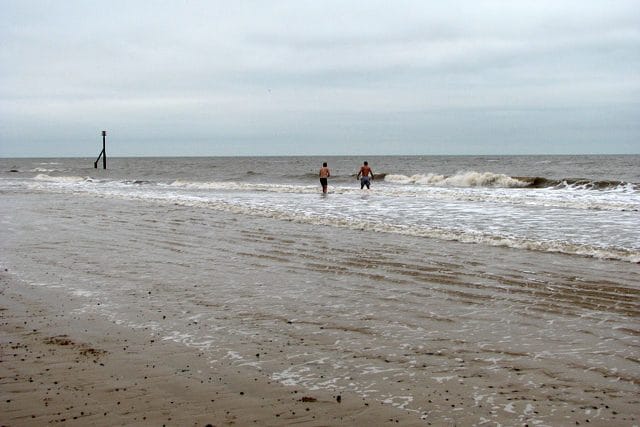
Do not jump or dive into cold open water. Wade in slowly, get your hands and face wet first, and give yourself sixty to ninety seconds standing chest-deep before you start swimming properly. This single habit change accounts for a large share of the difference between people who have a bad first experience and give up, and people who keep going.
Ignoring the get-out plan
The other recurring mistake is underestimating "afterdrop" — the continued drop in core body temperature that happens for ten to twenty minutes after you get out, as cold blood from your arms and legs circulates back to your core. This is why experienced swimmers change immediately, from the feet up, and get a warm drink into themselves within minutes rather than standing around chatting in a wet costume. A Dryrobe or equivalent changing robe (£90–£140, though budget own-brand versions from Decathlon run closer to £45) solves the modesty problem on a busy lido or beach and lets you change fast without a tent.
Starting properly, not heroically
Three to five minutes is a sensible ceiling for a first cold swim, and that is with a group, in a supervised or well-known safe spot, not alone. Outdoor Swimming Society local groups and organisations like Blue Tit Swimming Group exist specifically to give beginners supervised sessions and a get-out plan, and joining one for the first month is a better use of £20–£30 in membership than any piece of kit.
A neoprene swim hat (roughly £15–£25) and neoprene socks and gloves make a genuine difference to how long you can tolerate the water, because heat loss through the head, hands and feet is disproportionate to their surface area. A wetsuit is not cheating — plenty of serious cold water swimmers use one, especially through fifty-degree-Fahrenheit spring water, and the idea that "proper" swimmers go in skin-only is more macho posturing than evidence-based advice.
Why July is actually the easiest month to start
Most people picture cold water swimming as a midwinter activity, largely because that is what gets photographed for the papers every January. In practice, July is by far the more forgiving entry point. UK inland lakes and reservoirs typically sit between fourteen and eighteen degrees Celsius by mid-July, and the sea around most of the English and Welsh coast reaches sixteen to nineteen degrees at the same point in the season — genuinely cold enough to trigger the cold shock response and build real habituation, but nowhere near the four-to-eight-degree water that catches out January first-timers who have never done this before. Starting now means you get several months of regular swimming before autumn temperatures drop, so by the time the water gets properly cold in November, your body has already done the hard adaptation work.
Check a site-specific temperature reading before you go rather than trusting a general seasonal average. The Environment Agency and apps like Swim.com or the Outdoor Swimming Society's mapped locations often list recent readings for popular spots, and reservoirs can run several degrees colder than the coast on the same day because they lack the sea's thermal mass. A lake that "should" be seventeen degrees in July can still be closer to twelve if it is deep, shaded, or spring-fed, so the guideline is a starting point, not a substitute for checking.
Where the evidence runs out
Claims about cold water swimming curing depression specifically, rather than helping some people manage symptoms alongside existing treatment, go further than the current research supports. A small 2018 case study published in BMJ Case Reports followed one woman with depression through a course of open water swimming and reported improved mood — genuinely interesting, but a single case study is not evidence of a general effect, and no reputable source treats it as a replacement for therapy or medication. If you are managing a diagnosed mental health condition, cold water swimming might be a useful addition to what you are already doing. It should not be the plan on its own.
People with cardiovascular disease, uncontrolled high blood pressure, or a history of arrhythmia should talk to a GP before starting, full stop — the cold shock response genuinely does spike heart rate and blood pressure sharply enough to matter for anyone in that category. This is the one part of the wellness conversation around cold water swimming that gets glossed over most often, because it is inconvenient to the enthusiasm.
What is worth doing
Build up gradually, swim with people who know the water, get out before you are shivering hard rather than after, and treat the first month as habituation training rather than a fitness programme. Skip the ice bath at home if open water is available nearby — the physiological response is similar, but a natural body of water gives you movement, current awareness and a genuine skills element that a tub in the garden does not.