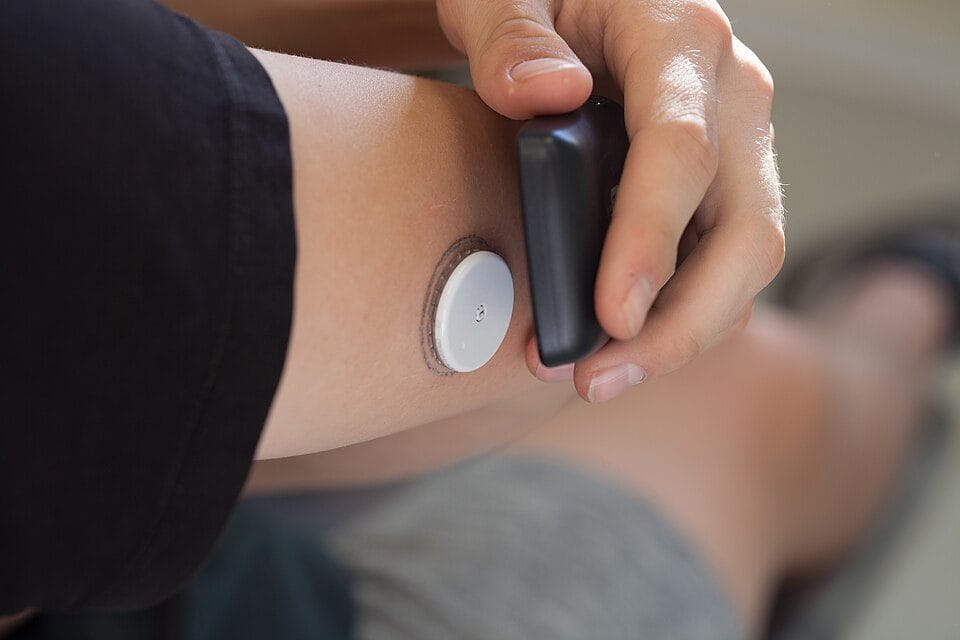
A friend of mine turned up to dinner not with a fitness tracker but with a small white sensor stuck to the back of her upper arm, the kind of thing you'd expect on a hospital ward rather than at a table ordering pasta. Glancing at her phone every few minutes throughout the meal, she watched a line climb after the bread basket and dip an hour later, treating her own blood sugar like a live football score. None of this had anything to do with diabetes — she isn't diabetic, and as far as either of us knows, she isn't pre-diabetic either. She'd simply paid roughly £59 for a fortnight of data and decided the graph was worth more to her than the wine.
What's actually stuck to your arm
Continuous glucose monitors, or CGMs, were built for people with diabetes and still do their most important work there. A small filament sits just under the skin, usually on the back of the upper arm, and reads the glucose level in the fluid between your cells every few minutes, day and night, for as long as the sensor lasts — typically 14 days before it needs replacing. Abbott's FreeStyle Libre popularised the format for clinical use in the UK; its consumer cousin, Lingo, launched here in January 2024 and is now sold both through hellolingo.com and on the shelf at Boots. Unlike the finger-prick test your GP might use once at an appointment, a CGM produces thousands of readings across a fortnight, which is precisely what makes the graph so hypnotic to watch. Sensors like these actually read interstitial glucose rather than blood glucose directly, lagging true blood sugar by roughly five to ten minutes, though they track closely enough for everyday patterns. That distinction rarely makes it into the adverts, which explains why a CGM reading and a finger-prick test taken at the same moment sometimes disagree.
The pitch behind the patch
The wellness case for wearing one, if you don't have diabetes, runs roughly like this: your blood sugar reacts to food, sleep, stress and exercise in ways a scale or a step count can't capture, and seeing those reactions in real time lets you adjust before problems start. Eat white toast at eight and watch the line spike, the argument goes, then swap in porridge with nuts the next morning and watch it flatten — instant, visual proof that one breakfast beats the other. Lingo's own marketing leans hard on the idea of glucose as a dashboard for your metabolism, something to be tuned the way you'd tune a car.
It's a seductive pitch, and not entirely wrong — glucose spikes are real, measurable, and do vary by food. What the pitch tends to leave out is what a normal spike looks like in someone with no metabolic problem whatsoever, and how much that varies from person to person for reasons that have nothing to do with breakfast.
What NICE and the NHS actually say
NICE has not changed its position on this, despite the marketing.
The National Institute for Health and Care Excellence recommends continuous or intermittently scanned glucose monitoring — devices like the NHS-funded FreeStyle Libre — specifically for people with type 1 diabetes and for people with type 2 diabetes who are on insulin. For everyone else, the guidance is unchanged: a balanced diet, roughly 150 minutes of moderate exercise a week, a healthy weight, and an NHS Health Check every five years from the age of forty. Routine self-monitoring of blood glucose at home is, in NICE's own wording, not recommended for adults without a specific clinical indication. If your last blood test came back borderline — what clinicians call non-diabetic hyperglycaemia — your GP can refer you to the NHS Diabetes Prevention Programme, a nine-month course of free coaching on diet and activity with considerably stronger evidence behind it than a fortnight of arm-patch data.
The £59 question
Ignore the marketing language for a moment and look at what this actually costs. Lingo's starter option is a single two-week sensor for around £59, though Abbott has also sold four-sensor bundles covering roughly two months of near-continuous wear for closer to £300. Move onto the rolling subscription and sensors get shipped automatically every twelve weeks, which is convenient right up until you forget to cancel it. None of this is subsidised: CGMs are only free on the NHS for the specific diabetic groups NICE names, so a curious non-diabetic is paying full retail for a device the health service explicitly does not think they need.
Even Zoe backed away from the sensor
Here's the detail that undercuts the whole trend better than any clinical guideline: even the company that helped make glucose-tracking fashionable has since backed away from it. Zoe, the personalised-nutrition business built around Tim Spector's gut microbiome research, spent years selling a home test built partly around a continuous glucose sensor worn on the arm alongside a fat-tolerance test involving a specially formulated muffin. In September 2025, Zoe dropped the sensor and the muffin test entirely. The company now predicts a customer's likely blood sugar and blood fat response using an algorithm trained on data from more than 300,000 existing microbiome profiles, rather than asking new customers to wear a patch for two weeks. A 2026 Zoe kit runs to roughly £149 for the gut test plus £9.99 a month for the app — noticeably cheaper, and considerably simpler, than the sensor-and-muffin combination it replaced. If the company that helped popularise glucose-tracking-for-wellness has quietly concluded the sensor wasn't earning its keep, that tells you more than a shelf full of testimonials ever will.
Who might genuinely benefit
None of this means the technology is useless — it means it's being sold to the wrong audience. A short, supervised spell of CGM use can produce real, actionable information for specific groups, and is worth discussing with a GP rather than trying alone:
- A parent or sibling with type 2 diabetes
- A previous diagnosis of gestational diabetes during pregnancy
- A borderline HbA1c reading flagged at your last NHS Health Check
- You're already working with a dietitian or GP on weight or metabolic health, in which case a short trial can add useful detail to that existing plan
A 2026 systematic review of CGM use in non-diabetic populations for cardiovascular prevention found the evidence still too limited to draw firm conclusions about outcomes, even as interest in the approach keeps growing. That's a fair summary of where things stand: promising enough to keep studying, nowhere near strong enough to justify a monthly subscription for someone with no risk factors at all. There's also a wrinkle even enthusiasts rarely mention — glucose spikes are not inherently harmful, and plenty of healthy people show sharper, faster swings after eating than some people with early insulin resistance, simply because of ordinary variation in gut transit time and meal composition. A single steep line on a graph, on its own, tells you far less than the marketing implies.
What actually moves the number
If you're genuinely curious about your metabolic health, start with what your GP can already tell you for nothing. Request your HbA1c reading at your next NHS Health Check and ask directly whether your result counts as borderline — skip the sensor until that conversation has happened, because a fortnight of arm-patch data with no baseline to compare it against is closer to entertainment than diagnosis. If you fall into one of the groups above, talk to your GP before spending anything; a short supervised trial is worth far more than a rolling subscription you interpret alone at the kitchen table. And if you just want the practical version of the experiment, swap one white-bread breakfast for porridge with nuts — you don't need £59 of hardware to notice you feel steadier by eleven o'clock.
My friend, for what it's worth, finished her pasta, watched the line climb exactly as she expected, and ordered the tiramisu anyway.