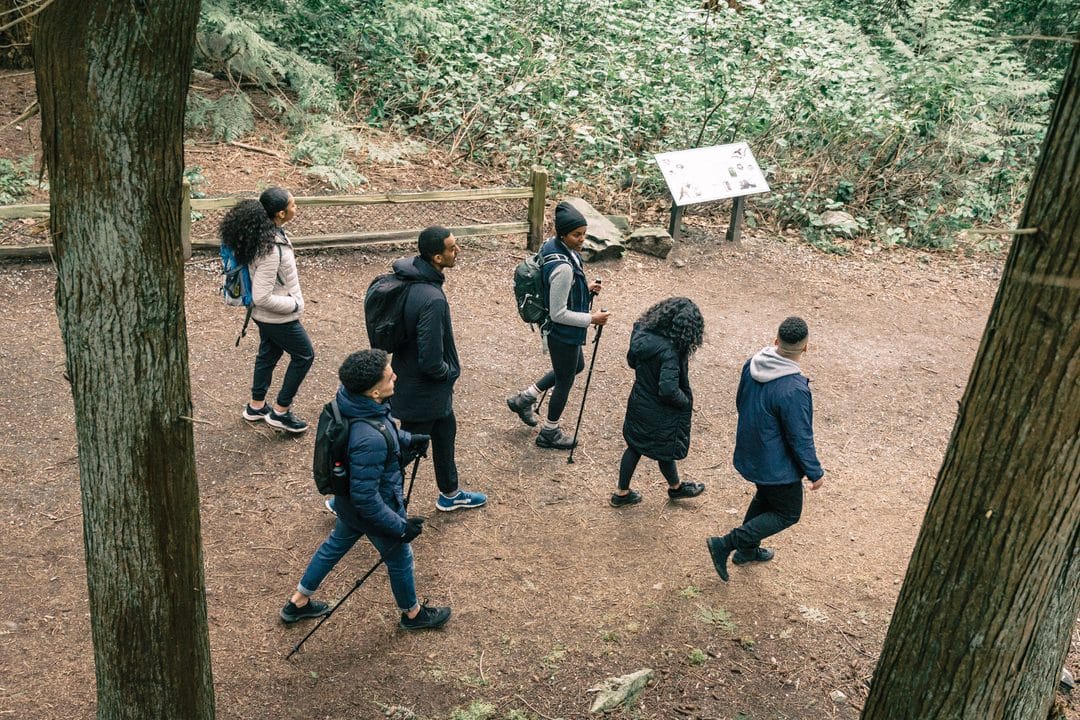
A patient in Shropshire is handed a prescription this month, and it is not for anything you can collect at Boots. It is a referral to a twelve-week programme of guided walks along the Severn, organised through a link worker at her surgery, at no cost beyond a decent pair of boots. This is social prescribing, and it has quietly become one of the NHS's more interesting responses to the fact that a large share of GP appointments have little to do with what medicine alone can fix.
The 120-minutes rule
The figure that keeps surfacing in this field comes from a 2019 study by Dr Mathew White and colleagues at the University of Exeter's European Centre for Environment and Human Health, published in Scientific Reports after analysing data from nearly 20,000 people. It found that adults who spent at least 120 minutes a week in green space — a local park, a stretch of coastal path, an allotment — reported significantly better health and higher wellbeing than those who spent none, regardless of income, ethnicity or whether they had a long-term illness. Crucially, the benefit plateaued around that two-hour mark; more time helped a little further, but the steepest gains came from simply crossing the threshold from zero to some. That number matters because it is achievable in a way that "exercise more" rarely is as advice. Two hours a week breaks down to a seventeen-minute walk each day, or three lunchtime loops of a local park on the days you can manage it. It does not require kit, a class timetable, or a discussion with your bank balance about a monthly direct debit. A standard gym membership in a UK city — PureGym runs from around £24.99 a month, Better leisure centres closer to £40 to £50 — is a real barrier for a lot of people the NHS is trying to reach, and green social prescribing sidesteps that barrier entirely.
What "green exercise" actually covers
The term is broader than a jog through the woods. NHS England's green social prescribing programme, expanded across seven test sites since 2021 with roughly £5.77 million of joint funding from NHS England, Defra and Sport England, covers activities as varied as community gardening, guided nature walks, conservation volunteering with The Conservation Volunteers' long-running Green Gym scheme, and blue-space activities such as wild swimming groups. A link worker — a role introduced through the NHS Long Term Plan in 2019 — sits down with a patient, discusses what's realistic given their mobility, transport and confidence, and matches them to a local group rather than handing over a leaflet and hoping.
Mind, the mental health charity, has run ecotherapy programmes since well before the NHS caught up, and their internal evaluations report that participants doing outdoor conservation work alongside a support worker showed measurable drops in reported anxiety after six weeks, alongside something harder to quantify: people said they felt part of something, which a solitary treadmill session rarely delivers. Group-based green activity appears to do two jobs at once — the physiological effects of movement and daylight exposure, plus the social contact that combats the isolation so many referrals are actually trying to treat.
Why outdoors beats indoors, physiologically
Set the social element aside and there is still a measurable difference between moving indoors and moving outdoors. Morning daylight exposure helps anchor the circadian rhythm, which in turn affects sleep quality and, downstream, mood regulation — this is well established in sleep medicine, not a green-space-specific claim, but it is one reason a 7am park walk does more for some people than a 7pm treadmill session under strip lighting. Exposure to natural environments has also been linked in multiple UK studies to lower cortisol readings after a stressful task, compared with the same task followed by time in an urban or indoor setting. None of this means the gym is pointless, and it would be dishonest to pretend green exercise is a like-for-like substitute for structured strength training or the cardiovascular gains of a spin class. If your goal is measurable fitness progression — tracked numbers, progressive overload, a marathon time you're chasing — a park walk will not get you there on its own. But if the goal named in the referral is "this person is isolated, anxious, and hasn't left the house except for appointments in three weeks," a woodland walking group solves a different problem than a rowing machine does, and it solves it more directly.
The access problem nobody quite fixes
Here's the uncomfortable bit that rarely makes it into the wellness coverage: green space in the UK is not distributed fairly.
A 2020 Public Health England review found that people living in the most deprived areas have access to five times less usable green space than those in the least deprived areas, and are far more likely to live near a park that feels unsafe or poorly maintained rather than one that invites a daily walk. Prescribing a walk in the park is a hollow gesture if the nearest park is a fifteen-minute bus ride away, or if it's the kind of place people avoid after dark. Some of the greener social-prescribing pilots — Sheffield's is a good example — have had to build transport support and buddy systems into the referral itself, because the intervention only works if people can actually get there safely.
What this looks like week to week
For anyone whose surgery does not yet offer a formal referral, the same principle works without the paperwork. Ramblers Wellbeing Walks runs free, short, graded group walks in dozens of towns and cities, aimed specifically at people who are inactive or recovering from illness rather than seasoned hikers. The Wildlife Trusts and TCV run conservation days that count toward the 120-minute target while giving you something to show for the afternoon — a cleared footpath, a planted hedgerow. And if a group setting feels like too much at first, the research on the 120-minute threshold doesn't require company: a solo walk counts just as much toward the tally, which matters for anyone whose anxiety makes a new group daunting before it becomes manageable.
- Start with a fixed, boring route near home rather than searching for somewhere scenic — consistency beats novelty in the first month.
- Log the minutes, not the distance. Fifteen minutes twice a day adds up faster than most people expect, and it removes the pressure to "properly exercise."
- If cost or transport is the barrier, ask your GP practice directly whether they have a link worker — most now do, though awareness of the service is still patchy, and a fair few patients simply never hear the offer exists.
The evidence, honestly weighed
It would overstate things to call green exercise a treatment for clinical depression in the way an antidepressant or CBT is a treatment — the evidence base, while growing, is still largely observational rather than built on large randomised controlled trials, and researchers including White's own team are careful to note that correlation between green space access and wellbeing doesn't prove the space itself causes the improvement rather than, say, people with more free time and better health choosing to live near it. What the data supports more confidently is green exercise as a genuinely low-risk, low-cost complement sitting alongside existing NHS mental health provision — not a replacement for a GP assessment when someone is in crisis, and not a substitute for medication when medication is what's needed, but a real option for the much larger group of patients whose problem is closer to low mood, poor sleep and isolation than to acute illness.
Twelve weeks of guided walking costs the NHS a fraction of a course of talking therapy and rather less than repeat prescriptions issued indefinitely because nobody addressed the isolation underneath the insomnia. Whether it scales nationally beyond the current pilot sites depends on funding decisions well above a GP's control. What it already proves, at a smaller scale, is that the walk to the park and back was never really about the steps.