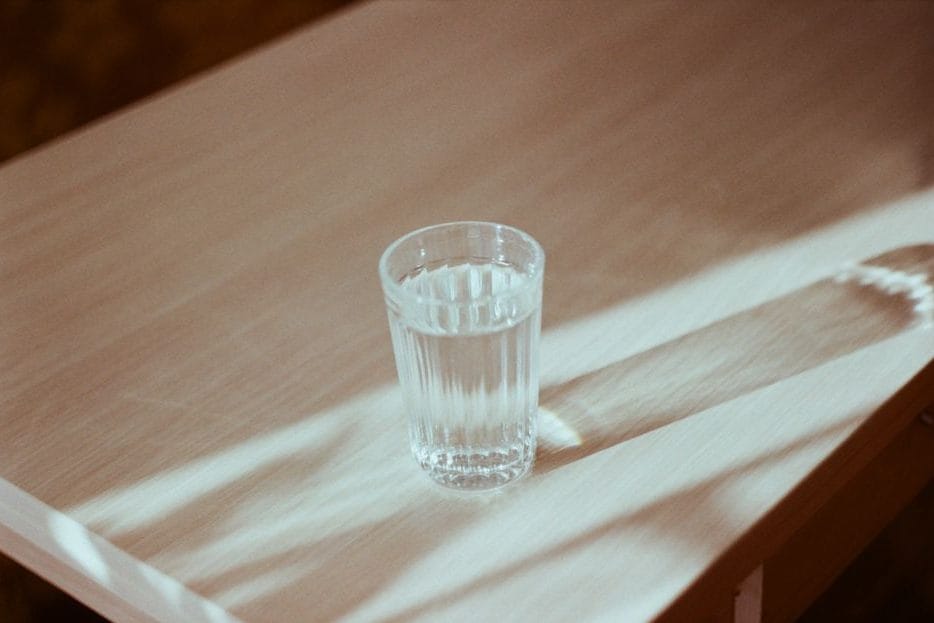
Every summer the same advice does the rounds: drink eight glasses of water a day. It's tidy, it's memorable, and it was never based on much. The truth is that how much you need shifts with the weather, what you're doing and how big you are — and in a proper heatwave, the standard guidance quietly stops being enough.
None of this needs to be complicated. You don't need an app counting millilitres or a two-litre bottle glued to your hand. You just need to understand what your body is actually doing when the temperature climbs, and a few habits that make keeping up with it almost automatic.
Why hot weather changes the maths
When you're warm, your body sweats to cool itself down. That's the whole point of sweat — it's your built-in air conditioning. But every drop you lose has to be replaced, and on a hot day you can lose far more than you'd guess, especially if you're moving about. You can be losing fluid steadily without ever feeling visibly drenched, because in dry heat it evaporates almost as fast as it appears.
This is where the eight-glasses rule falls down. It's a rough average for a mild day spent indoors. Spend an afternoon in the garden at 30 degrees, or walk into town and back, and your needs can climb well beyond that. The figure isn't fixed, and treating it as a fixed target is how people end up quietly behind.
The signs you're falling behind
Thirst is a useful signal, but it's a lagging one — by the time you feel genuinely thirsty, you're already a little low. That's not cause for alarm, but it's worth knowing so you can drink before you're parched rather than after. The more reliable everyday check is simpler and slightly unglamorous: look at the colour of your urine. Pale straw means you're doing fine. Dark, like apple juice, means top up.
Other early signs are easy to miss because they don't shout. A headache that creeps in by mid-afternoon. Feeling foggy or unusually tired when you've done nothing to earn it. A dry mouth, or feeling lightheaded when you stand up quickly. On their own each is minor; together, on a hot day, they're usually your body asking for a glass of water rather than a coffee.
Some people need to be more careful than others. Older adults often feel thirst less keenly, so the signal arrives late or not at all. Young children dehydrate faster than adults. And anyone on certain medications — water tablets are the obvious one — should have a word with their pharmacist about hot weather, because the usual rules can shift.
What actually works
Drink little and often
Sinking a pint of water in one go does less than you'd hope — a fair bit of it passes straight through. Sipping steadily through the day keeps you topped up far more effectively. The trick is to make it easy to remember, which usually means making it visible.
- Keep a glass or bottle where you'll see it — on the desk, the kitchen counter, by the sofa.
- Drink a glass with each meal as a default, so three are taken care of without thinking.
- Have one by the bed and one first thing in the morning — you wake up mildly dehydrated after a night's sleep.
It doesn't all have to be water
Plain water is the simplest option, but it's not the only one that counts. A cup of tea hydrates you despite the old myth that caffeine dries you out — the fluid far outweighs any mild diuretic effect. Squash, milk, and the water in fruit and veg all add up. Cucumber, strawberries, melon and tomatoes are mostly water, which is partly why a salad feels so right in the heat.
What works against you is the obvious stuff. A long session in the sun with several pints does the opposite of hydrate, and you'll feel it the next morning. Very sugary drinks aren't ideal either. None of this means you can't enjoy a cold beer in the garden — just match it with water alongside, and don't let it be the only thing you drink all afternoon.
When sweating hard, replace more than water
For most of us on a hot day, water and a normal diet cover everything. But if you've been exercising hard, gardening for hours, or sweating heavily, you lose salts as well as fluid. That's when a glass of water plus something salty — or a rehydration sachet from the chemist — does more than water alone. You don't need expensive sports drinks for ordinary days; save those for when you've genuinely worked up a sweat.
Beyond the glass
Hydration is only half the story in a heatwave. The other half is not overheating in the first place. Keep curtains or blinds closed on the sunny side of the house during the day, then open up once the evening cools. Loose, light clothing helps your sweat do its job. And the hottest part of the afternoon, roughly between eleven and three, is the time to slow down rather than mow the lawn or go for a run.
If someone does overheat — confused, stopped sweating despite the heat, or with a very high temperature — that's beyond a glass of water. Get them somewhere cool, cool them down, and call 999 if they don't improve quickly. Heatstroke is a medical emergency, not something to wait out.
The short version
Forget the eight glasses. Drink a little and often, check the colour rather than counting the cups, eat your way to some of it through fruit and veg, and pay extra attention if you're older, looking after children, or out in the sun for hours. Do that and you'll sail through the hot spell feeling clear-headed rather than wrung out.
It's about the least glamorous bit of summer wellbeing there is. It's also the one that makes the most difference to how you feel by teatime.